
Joint OxfordXML seminar together with the 6th Signal Processing and Monitoring (SPaM) in Labour International Workshop to this set of talks on machine learning
Audience: Public Format: Hybrid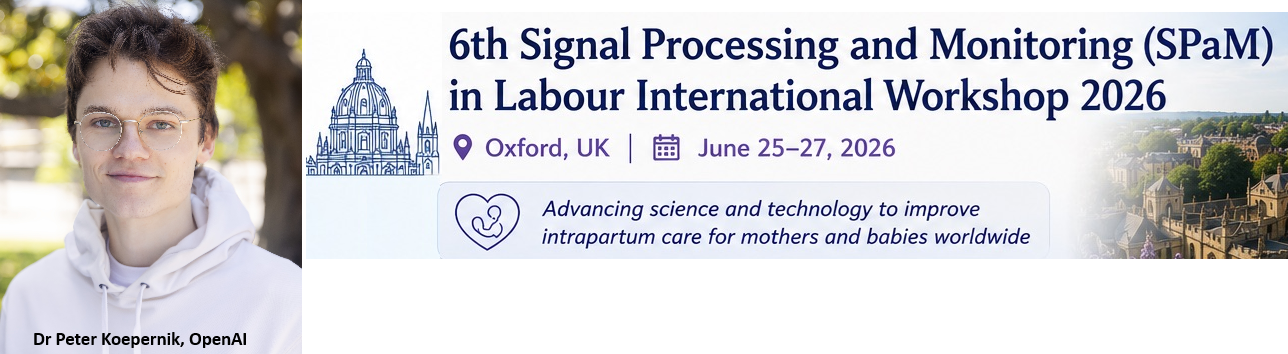
The Oxford XML Cluster is pleased to invite you to a joint seminar on machine learning, applications and more.
Thursday, 25 June 2026, 3.45pm to 6.15pm
The Oxford XML Cluster is pleased to invite you to a joint seminar together with the 6th Signal Processing and Monitoring (SPaM) in Labour International Workshop to this set of talks on machine learning, applications and more.
Date: Thu, 25 Jun 2026 | 15:45 - 18:15 (come and go as you please)
Location: Wolfson College, Leonard Wolfson Auditorium
Event URLs: OxfordXML: The Cross-disciplinary Machine Learning Community (https://oxfordxml.github.io/) and SPaM in Labour Workshop (https://users.ox.ac.uk/~ndog0178/spam2026.htm)
MS Teams Event: https://teams.microsoft.com[…]f77-b979-7c49923c3b36%22%7d
Schedule:
Cake and coffee in the Buttery at 15:45-16:15
16:15-16:35 Sheng Wong, University of Oxford (UK)
PRISM-CTG: A Foundation model for cardiotocography analysis with multi-view SSL
16:35-16:55 Maria Signorini, University Milano (Italy)
Analysis of Fetal Heart Rate antepartum: multiparametric methods and artificial
intelligence contribution
16:55-17:15 Martin Frasch (US)
Pregnancy health monitoring: where are we headed? Experiences using the recently
released 10M ECG foundation model and more
17:15-18:00 XML Cluster event: Peter Koepernik, OpenAI
Memory Learning under Partial Observability
Open end: Whole room discussion
Abstract for Dr Koepernik's talk: When a reinforcement learning agent has access only to partial observations of its environment, optimal decision-making generally requires retaining and using information from the past. This work characterizes the properties a learned memory representation must satisfy for an optimal policy to be expressible as a function of that representation. Building on this, we introduce an auxiliary training objective that encourages deep reinforcement learning agents to learn such memory functions. Empirical results across a diverse set of environments demonstrate that this approach can substantially improve performance under partial observability.
Bio for Dr Koepernik: Peter is a Research Scientist at OpenAI working on sub-quadratic attention mechanisms to improve long-context performance of large language models. He recently completed a DPhil in Statistics at Oxford, with research in probability theory, stochastic analysis, numerical SDE methods, and reinforcement learning under partial observability. More broadly, he is interested in how mathematical approaches can help make machine learning algorithms more scalable, robust, and useful.
Series: Oxford Cross-Disciplinary Machine Learning (OxfordXML) Research Cluster Seminar Series
Venue:
Wolfson College - Leonard Wolfson Auditorium
-
Leonard Wolfson Auditorium Wolfson College Linton Road Oxford Oxfordshire OX2 6UD United Kingdom
Department: Wolfson College (College)
Organiser: Prof. Antoniya Georgieva and Dr Csaba Botos
Host: OxfordXML