
Slippery boundaries: Fat tissue and the collapse of the subject-object divide in anatomical dissection practices
Audience: Public Format: In Person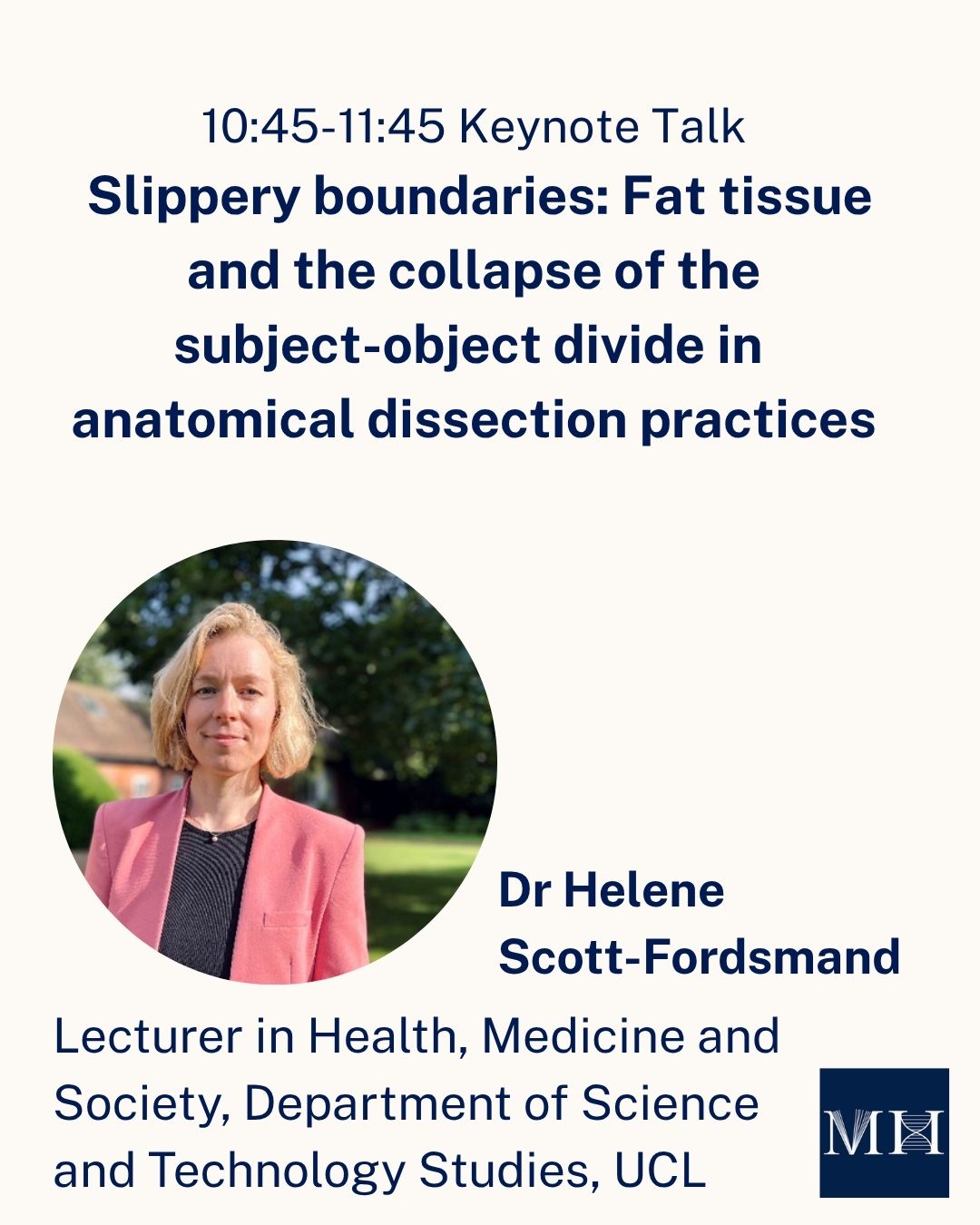
Keynote talk of the Objectivity and Subjectivity in Medicine workshop. Everyone welcome
Friday, 19 June 2026, 10.45am to 12pm
In this talk, I combine observations of fat tissue in a medical dissection hall and existentialist philosophy, and contrast this to traditional medical humanities approaches, to argue that the material aspect of dissection teaches an important lesson about the relation between the object and the subject body in medicine. Traditionally, medical humanities urge for the recognition that medicine operates on human bodies which are both objects and subjects, both biological organisms and encultured human beings. In anatomical dissection, for example, this means learning facts about anatomical structures while adding an existential-cultural layer addressing topics like death, donation, and autonomy. Medical students thus learn to recognise donor bodies as anatomical, epistemic objects, and as (former) subjects to whom they have moral obligations. While the combination certainly has value, this framing maintains a traditional dualist distinction between the body as object and as subject, and misses out on the inherent materiality of medicine. Invoking Sartre’s analysis of slime, I argue that fat tissue – like slime – by way of its materiality, makes boundaries between object and subject slippery. The unctuous nature of fat tissue means that it spreads and transgresses attempts of control: it sticks to gloves and instruments, making the epistemic task difficult, and it occasionally transfers on to skin, clothes, or notes, travelling with the students beyond the dissection hall, disrupting moral rituals of containment. Resisting material separation in this way, fat tissue quite literally collapses the distinction between the object and the subject of enquiry, as students themselves become both biologically and morally entangled with donors. While medical humanities can support students in seeing patients as subjects, the material human body silently teaches medical students and practitioners its own non-dualistic lessons about an entangled reality which implicates not only a more complex patient view, but an existential shift on the side of the practitioner.
Speaker(s): Helene Scott-Fordsmand (University College London)
Series: TORCH Medical Humanities
Venue:
Schwarzman Centre - Room 00.063 (ground floor)
-
Room 00.063 (ground floor) Schwarzman Centre Radcliffe Observatory Quarter, Woodstock Road Oxford Oxfordshire OX2 6GG United Kingdom
Department: Humanities (Division)
Organiser: Alberto Giubilini
Host: Alberto Giubilini
More info:
Keynote talk of the Objectivity and Subjectivity in Medicine workshop. Everyone welcome