
The Osinoni War: A new history of the Kedong Massacre (1895)
Audience: Public Format: Hybrid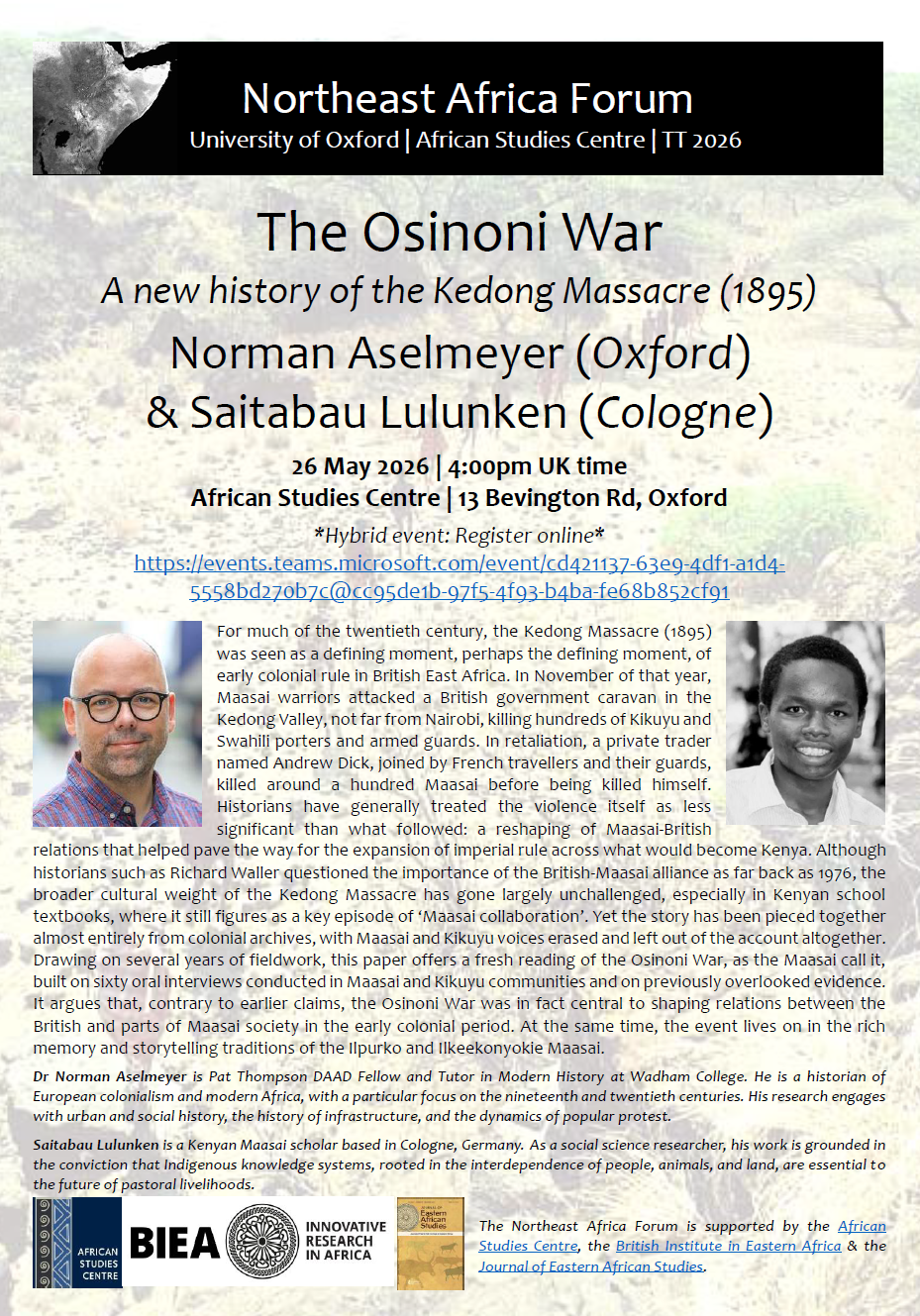
Seminar with Norman Aselmeyer (Oxford) & Saitabau Lulunken (Cologne). *Hybrid event* Webinar registration via link below
Tuesday, 26 May 2026, 4pm to 5.30pm
For much of the twentieth century, the Kedong Massacre (1895) was seen as a defining moment, perhaps the defining moment, of early colonial rule in British East Africa. In November of that year, Maasai warriors attacked a British government caravan in the Kedong Valley, not far from Nairobi, killing hundreds of Kikuyu and Swahili porters and armed guards. In retaliation, a private trader named Andrew Dick, joined by French travellers and their guards, killed around a hundred Maasai before being killed himself. Historians have generally treated the violence itself as less significant than what followed: a reshaping of Maasai-British relations that helped pave the way for the expansion of imperial rule across what would become Kenya. Although historians such as Richard Waller questioned the importance of the British-Maasai alliance as far back as 1976, the broader cultural weight of the Kedong Massacre has gone largely unchallenged, especially in Kenyan school textbooks, where it still figures as a key episode of ‘Maasai collaboration’. Yet the story has been pieced together almost entirely from colonial archives, with Maasai and Kikuyu voices erased and left out of the account altogether. Drawing on several years of fieldwork, this paper offers a fresh reading of the Osinoni War, as the Maasai call it, built on sixty oral interviews conducted in Maasai and Kikuyu communities and on previously overlooked evidence. It argues that, contrary to earlier claims, the Osinoni War was in fact central to shaping relations between the British and parts of Maasai society in the early colonial period. At the same time, the event lives on in the rich memory and storytelling traditions of the Ilpurko and Ilkeekonyokie Maasai.
Dr Norman Aselmeyer is Pat Thompson DAAD Fellow and Tutor in Modern History at Wadham College. He is a historian of European colonialism and modern Africa, with a particular focus on the nineteenth and twentieth centuries. His research engages with urban and social history, the history of infrastructure, and the dynamics of popular protest.
Saitabau Lulunken is a Kenyan Maasai scholar based in Cologne, Germany. As a social science researcher, his work is grounded in the conviction that Indigenous knowledge systems, rooted in the interdependence of people, animals, and land, are essential to the future of pastoral livelihoods.
Speaker(s): Norman Aselmeyer (Oxford), Saitabau Lulunken (Cologne)
Series: Northeast Africa Forum
Venue:
African Studies Centre - Seminar Room
-
Seminar Room African Studies Centre 13 Bevington Road Oxford Oxfordshire OX2 6NB United Kingdom
Department: African Studies Centre (Unit)
Organiser: Jason Mosley
Host: Northeast Africa Forum
Register here: https://events.teams.microsoft.com/event/cd421137-63e9-4df1-a1d4-5558bd270b7c@cc95de1b-97f5-4f93-b4ba-fe68b852cf91