
ScholarTHON: Computational Approaches to Visual and Material Culture in Arts & Humanities Research
Audience: Member of University - ALL Format: In Person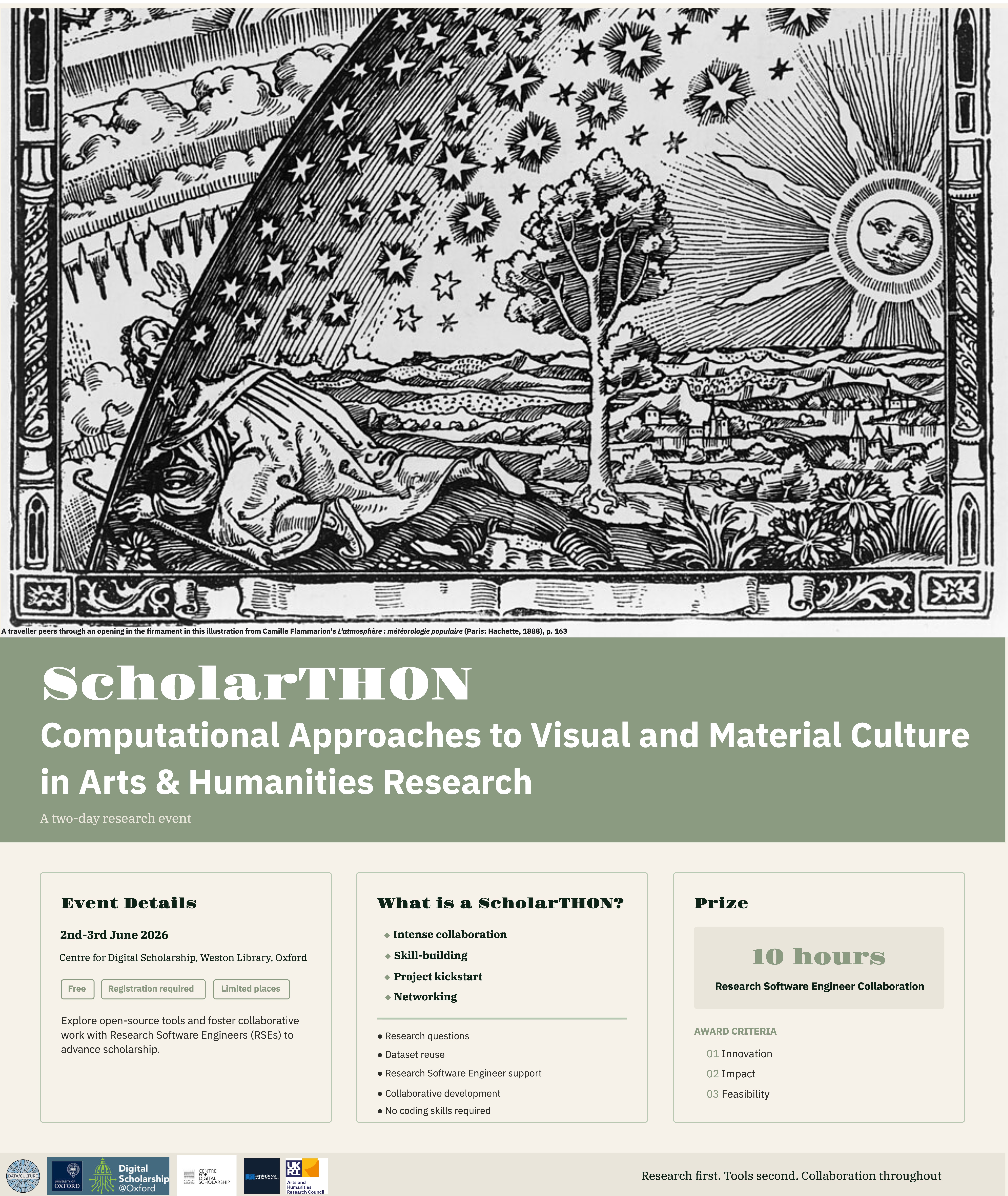
A two-day thematic research event on computational approaches to visual and material culture.
Tuesday, 2 June 2026 to Wednesday, 3 June 2026, 9.30am - 5pm
Free event and open to all. Registration required, limited places available. Please follow the link below to register.
Data/Culture, the Centre for Digital Scholarship (Bodleian Libraries), Digital Scholarship @Oxford, and Mapping the Arts and Humanities (SAS, London) are hosting a two-day thematic research event exploring new ways of working with images, objects, and performances. The event focuses on developing research questions and approaches, using existing tools and resources. Participants will work collaboratively in small groups, supported by Research Software Engineers, and have the opportunity to develop a research idea further through a prize of dedicated technical collaboration. No prior coding experience is required.
What is a ScholarTHON?
This pilot event explores a collaborative, research-led adaptation of the increasingly widespread hackathon format - originally developed in Computer Science as an intensive and collaborative way of working - for Arts and Humanities contexts.
A hackathon is typically a short, intensive and collaborative event in which participants work together in groups to solve computational challenges. This event builds on that format but shifts the focus towards research questions, placing Arts and Humanities scholars and their specific needs and expertise at the centre.
It brings Arts and Humanities researchers together with existing open-source tools and embedded Research Software Engineers to explore feasible and reusable approaches to visual search and image comparison across Arts and Humanities research contexts.
The event retains a competitive element, drawing on the hackathon format, but reorients it towards research impact. Awards will be given for the most compelling research question and the most reusable and scalable approach.
The winning group will receive 10 hours of dedicated collaboration with a Research Software Engineer. This will support the further development or adaptation of tools in line with the research project, helping to move from initial ideas to sustainable research outputs and supporting the development of collaborative grant applications across disciplines and sectors.
Conceptual Framework
This model addresses fragmented expertise, uneven access to technical skills, the underuse of existing datasets and tools, and weak pathways from experimentation to sustainable outputs.
During the course of the ScholarTHON, participants will be introduced to current research initiatives that are already working to address these challenges, including Data/Culture, Mapping the Arts and Humanities, and the Open-Source Initiative at Digital Scholarship @Oxford. These projects demonstrate how datasets, software, and research communities can be connected and sustained through practices of reuse, collaboration, and shared development.
By aligning research questions, skills, tools, and collaboration, the ScholarTHON operates as a small-scale knowledge ecosystem that supports stronger and more fundable projects, improves the reuse of digital resources, and models more sustainable research infrastructure practices.
What will happen?
This event focuses on computational approaches to visual and material culture to explore how images, objects, and performances can be studied using open-source tools and frameworks.
Participants will complete a short MS Form in advance of the event outlining their research interests, questions, and ,where possible, datasets or collections they wish to work with. This will help us identify needs, refine research questions, and organise groups ahead of the programme.
Over the two days, participants will:
explore a curated selection of open-source tools (e.g. VISE, WISE, Image Compare)
learn how to navigate and assess open-source resources, including GitHub repositories
examine how these tools have been used in existing research projects
work in small interdisciplinary groups, each supported by an embedded Research Software Engineer
develop a conceptual prototype: a structured proposal outlining how tools and datasets could be used to address a research question
The outcome is not a finished digital product, but a clear, realistic research approach, including workflows, methods, and next steps that can inform the future of the project and its applications. The full programme and MS form will be shared with participants at the sign-up stage.
Who is this for?
This event is designed for:
Arts and Humanities researchers (scholars and postgraduate students)
those working with images, objects, archives, or performance materials
those interested in exploring new research methods
those developing or planning research projects or grant applications
What do you need?
An interest in your research question
(Optional) a dataset or collection you work with
A laptop is desirable but not essential
You do NOT need:
coding experience
prior knowledge of tools
technical expertise
Venue:
Weston Library
-
Weston Library Broad Street Oxford Oxfordshire OX1 3BG United Kingdom
Department: School of Anthropology & Museum Ethnography (Department)
Organiser: Giovanna Di Martino
Host: Centre for Digital Scholarship, Weston Library, Oxford
Register here: https://www.eventbrite.co.uk/e/1988909140780?aff=oddtdtcreator