
Title TBC - CAMS Oxford Institute Seminar
CAMS Oxford Institute - Seminar Series
CAMS Oxford Institute - Seminar Series
Tuesday, 21 July 2026, 9.30am to 10.30am
Venue:
Henry Wellcome Building Rooms A & B
Room A+B Wellcome Trust Centre for Human Genetics Headington Oxford Oxfordshire OX3 7BN United Kingdom
Department: NDM (CAMS Oxford Institute) (Unit)
Host: Ricardo Fernandes, Dannielle Wellington, Mimie Szyk
Series: CAMS Oxford Institute - Seminar Series
Audience: Member of University - ALL Format: In Person

Introducing OxTRE (University of Oxford Trusted Research Environment)
An introduction to OxTRE, the University's first centralised platform for storing highly-sensitive research data.
This event is aimed at researchers, research facilitators, teams working with highly sensitive data, and teams interested in secure data management. Researchers across the University are increasingly working with highly sensitive data that requires secure, compliant environments for storage and analysis. OxTRE is the University of Oxford's first centralised Trusted Research Environment (TRE), designed to provide a secure platform for working with sensitive research data. Join us to learn how OxTRE could support your research and provide a streamlined route through the approvals processes. You'll hear about the wider landscape for Trusted Research Environments, see a live demonstration of the platform, learn about its security and governance, and gain an overview of the service roadmap, support, and pricing. We also invite you to stay and continue the conversation over refreshments. This event is also an opportunity to help shape the future of OxTRE. We're keen to hear from researchers who work with, or anticipate working with, highly sensitive data so we can ensure the service is developed around the needs of Oxford's research community. Your feedback will directly inform the next stages of development. Please use the link to register your interest. This is a space-limited event so we'll respond with a meeting invite if there is capacity.
Tuesday, 21 July 2026, 1pm to 3.30pm
Venue:
Examination Schools - South School
South School Examination Schools 75-81 High Street Oxford Oxfordshire OX1 4BG United Kingdom
Department: IT Services (Unit)
Organiser: Sreya Rao
Host: OxTRE Delivery Team
Audience: Member of University - Staff Format: In Person
Beyond the bump: How managing blood pressure around pregnancy shapes your future health.
This talk will explore how pregnancy is a window into future health, giving an opportunity to improve long-term care and
Many women experience high blood pressure during pregnancy, and it is increasingly recognised as an early warning sign for health problems later in life. Conditions such as gestational hypertension and preeclampsia are known to increase a woman’s longer-term risk of stroke, heart disease and dementia. Yet most women receive little follow-up once their baby is born. Recent studies by University of Oxford researchers have shown that, by monitoring and carefully managing their blood pressure after giving birth, new mothers could cut their risk of future heart disease and strokes – and protect their long‑term brain health. The studies, supported by the NIHR Biomedical Research Centre: Oxford, have led to the creation of a postpartum cardiac risk clinic in the Oxford Heart Centre. This talk will explore how pregnancy is a window into future health, giving an opportunity to improve long-term care and help prevent future cardiovascular disease and cognitive decline in women. The speakers will also show how understanding why some women develop long-term complications while others recover fully could lead to more personalised treatment.
Tuesday, 21 July 2026, 2pm to 3pm
Department: Medical Sciences (Division)
Host: Oxford Biomedical Research Centre
Audience: Public Format: Online
Dr Feng Zhang - Title TBA
Ludwig External Seminar
Tuesday, 21 July 2026, 2.15pm to 3.15pm
Speaker(s): Dr Feng Zhang
Venue:
NDM Building
NDM Building Headington Oxford Oxfordshire OX3 7FZ United Kingdom
Venue details:
Seminar Room
Department: Oxford Branch of the Ludwig Institute for Cancer Research (Unit)
Organiser: Marie-Laure Foisneau-Bates
Host: Prof Yang Shi
Series: Ludwig Institute External Seminar Series
Audience: Member of University - ALL Format: In Person
Book Talk: 'Global Portuguese: Literary, Historical, Sociolinguistic and Anthropological Approaches’ (Brill, Leiden, 2025)
Book Talk - registration is not required.
Professor Shihan de Silva Jayasuriya will present ‘Global Portuguese: Literary, Historical, Sociolinguistic and Anthropological Approaches’ (Brill, Leiden, 2025).
Tuesday, 21 July 2026, 3pm to 5pm
Speaker(s): Professor Shihan de Silva Jayasuriya (Institute of Commonwealth Studies, University of London & Faculty of History, University of Oxford), D.ra Ângela Sarmento-D (Language Centre-OLL, University of Oxford & Instituto de Literatura Comparada ML-FLUP, University of Porto), D
Venue:
Schwarzman Centre - Room 20.402
Room 20.402 Schwarzman Centre Radcliffe Observatory Quarter, Woodstock Road Oxford Oxfordshire OX2 6GG United Kingdom
Department: History (Department)
Audience: Public Format: In Person
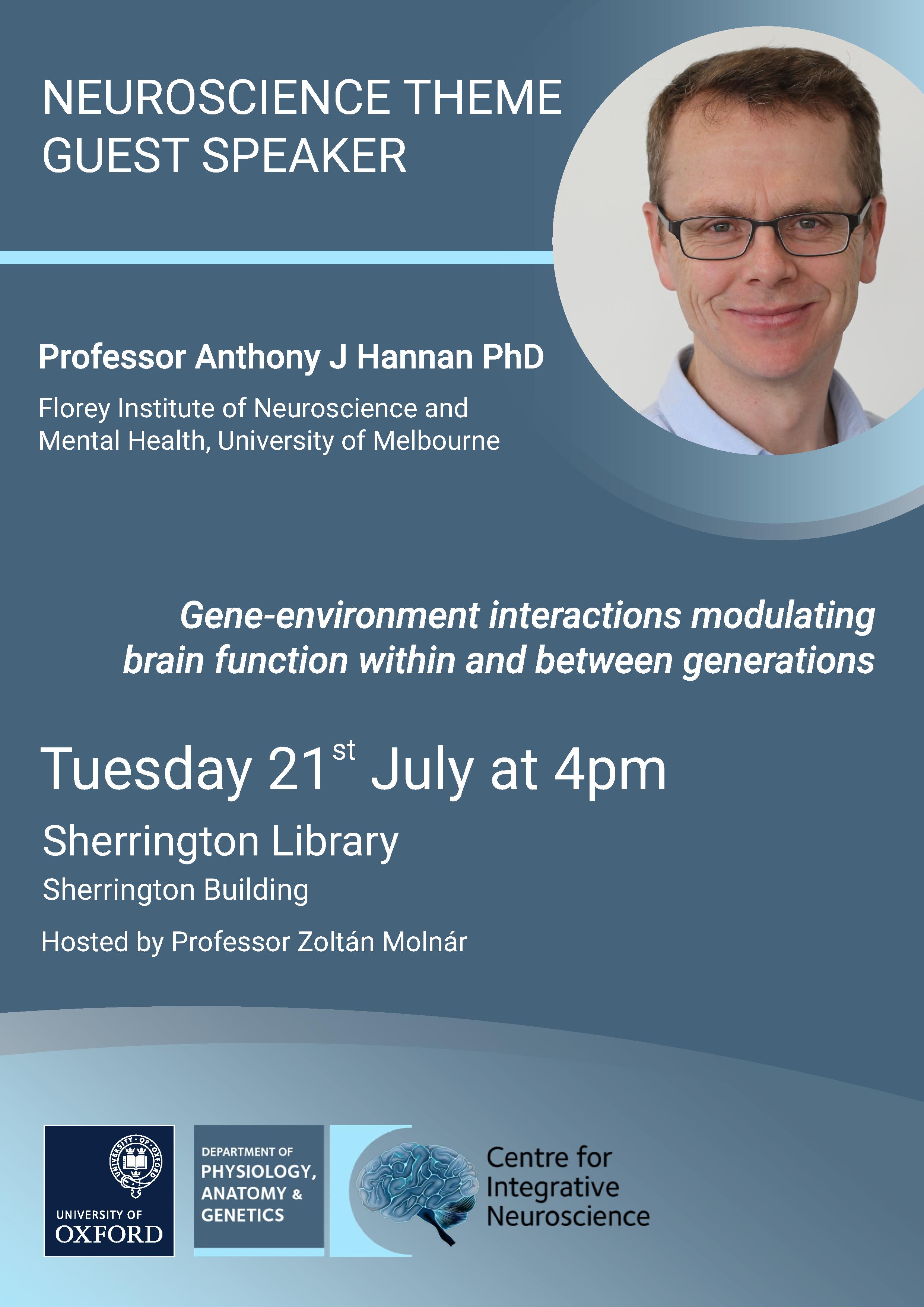
DPAG Neuroscience Seminar: 'Gene-environment interactions modulating brain function within and between generations'
We are interested in how gene-environment interactions mediate and modulate brain function, in health and disease. Our findings have revealed key pathways implicated in the therapeutic impacts of environmental stimuli and identified novel therapeutic targets. We have also discovered altered brain-body interactions, including the first evidence of gut dysbiosis (dysregulated gastrointestinal microbiota) in Huntington’s disease (where we model depression, dementia and motor symptoms) and a genetic model of schizophrenia. Furthermore, we have shown that high-fibre diet and prebiotic interventions improved gut function and ameliorated cognitive and affective dysfunction. Ongoing studies are exploring the gut microbiome as a therapeutic target and the possibility that specific environmental factors may modulate brain function via microbiota-gut-brain interactions. These approaches to gene-environment interactions may facilitate the development of enviromimetics (including exercise mimetics as a subclass) for various brain disorders. In order to understand how gene-environment interactions may sculpt brain development and function between generations, we have also been exploring epigenetic inheritance via the paternal lineage. We have discovered intergenerational effects of various paternal exposures, including exercise, stress, infection, immune activation, antibiotics and other drugs. These lifestyle factors and experiences modulate sperm noncoding RNAs and alter offspring phenotypes. We are exploring epigenetically mediated changes in the brains of offspring. The effects on offspring, including modulation of brain function and behaviour, via epigenetic inheritance, have particular relevance to the pathogenesis of depression and anxiety disorders.
Tuesday, 21 July 2026, 4pm to 5pm
Speaker(s): Professor Anthony Hannan (University of Melbourne)
Venue:
Sherrington Building - Sherrington Library
Sherrington Library Sherrington Building off Parks Road Oxford Oxfordshire OX1 3PT United Kingdom
Department: Physiology Anatomy and Genetics (Department)
Host: Professor Zoltan Molnar
Series: DPAG Neuroscience Seminars
Audience: Member of University - ALL Format: In Person
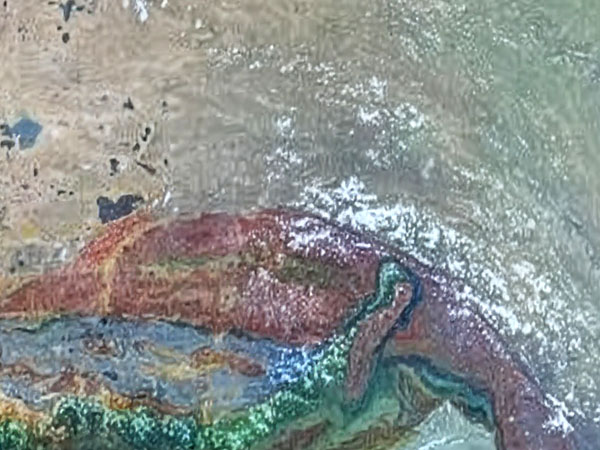
A new Geological Map of the Greater Himalayan Ranges
Talk on a new geological map (scale: 1:1.5 M) of the Greater Himalayan Ranges .
A new geological map (scale: 1:1.5 M) of the Greater Himalayan Ranges has been compiled and will be published in two sheets. The Western Sheet includes the Pamir, Hindu Kush, Karakoram, Kohistan, Ladakh ranges, including SW Tibet, with the Nanga Parbat syntaxis, and the Pakistan and Indian Himalaya.
Tuesday, 21 July 2026, 6.30pm to 7.30pm
Venue:
University Museum of Natural History
University Museum of Natural History Parks Road Oxford Oxfordshire OX1 3PW United Kingdom
Venue details:
Westwood Room
Department: Oxford University Museum of Natural History (Department)
Organiser: Oxfordshire Geology Trust
Host: Oxford University Museum of Natural History
Series: Oxfordshire Geology Trust Talks
Audience: Public Format: In Person
Lunch & Learn | MSD Discovery Day
Join Dr Minu Ganesan and Dr Lindsey Marsh from Meso Scale Diagnostics (MSD) to learn about their ultra sensitive, high throughput, customizable, multiplex biomarker solutions, and robust instrumentation already available within the IDRM. Lunch will be provided so please register your attendance and dietary requirements.
Wednesday, 22 July 2026, 11am to 12.30pm
Venue:
IMS-Tetsuya Nakamura Building - IDRM Seminar Rooms 1&2
IDRM Seminar Rooms 1&2 IMS-Tetsuya Nakamura Building Roosevelt Dr, Headington Oxford Oxfordshire OX3 7TY United Kingdom
Venue details:
Seminar Rooms 1&2
Department: IDRM (DPAG) (Unit)
Audience: Member of University - ALL Format: In Person
Good Clinical Practice (GCP) for Labs (DATE SWITCH originally scheduled for 15 July)
Principles of Good Clinical Practice (GCP) for staff working in laboratories handling samples derived in clinical trials
Laboratories handling samples derived from Clinical Trials of Investigational Medicinal Products (CTIMPs) are legally obliged to adhere to Good Clinical Practice (GCP). But what does this mean in practice? This course will provide a brief overview of CTIMP design and delivery, then guide you through the principles of GCP and what this means from the perspective of the laboratory. Key areas covered include: >Requirements of a Quality Management System >Roles and responsibilities >Participant consent >Ensuring data integrity >Managing errors, deviations and incidents >Archiving >MHRA inspections Email rgea.training@admin.ox.ac.uk to book this session date.
Wednesday, 22 July 2026, 12.30pm to 4.30pm
Department: Medical Sciences (Division)
Organiser: Research Governance, Ethics & Assurance (RGEA) Training
Host: Training provided by Research Governance, Ethics & Assurance
Audience: Member of University - ALL Format: In Person
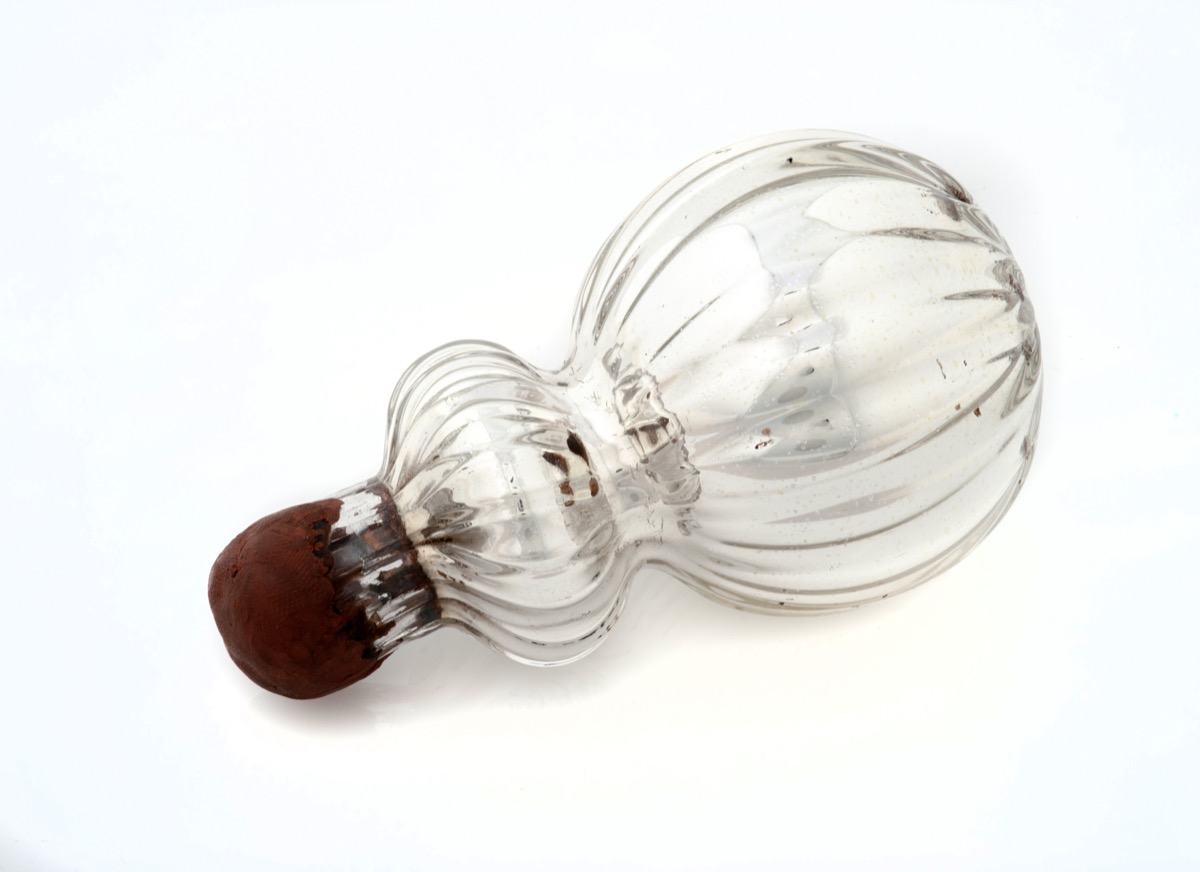
Witchcraft, Amulets and Magic Tour
Go on a special tour of the galleries & hear intriguing stories behind magical & mystical objects from around the globe!
What purpose does the belief in magic and witchcraft serve in cultures throughout time and across the globe? Why have people from historical times up to the current day placed their faith in 'lucky' objects to ward off ill fortune and keep themselves safe? Is there really a witch in a bottle? How could you cure a wart using a slug? Is it possible to protect yourself from a snake bite using a seed pod? What connects our much-loved Witch in the Bottle with an old onion and an ancient slug on a twig? Go on a special tour of the galleries and hear the intriguing stories behind magical and mystical objects from around the globe and explore why magic and witchcraft still have an enduring fascination across different cultures and ages.
Wednesday, 22 July 2026, 2pm to 3pm
Department: Gardens, Libraries & Museums (Division)
Organiser: Pitt Rivers Museum
Host: Pitt Rivers Museum
Audience: Public Format: In Person
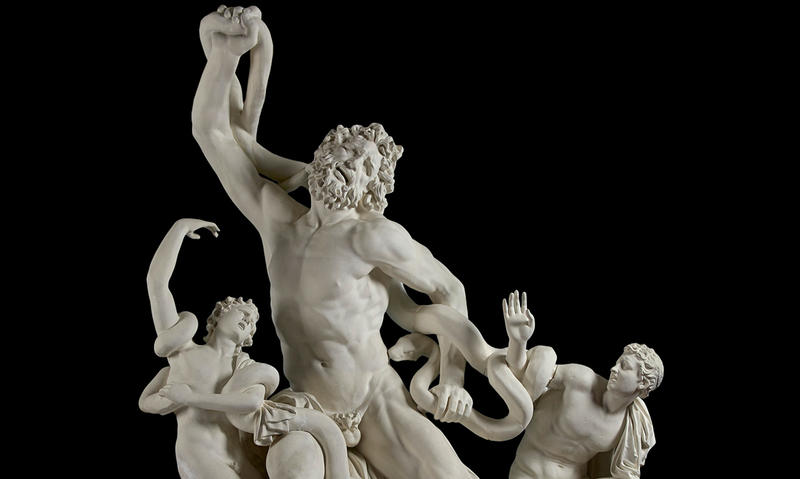
Members' Exclusive Tour — After Hours Cast Gallery Tour
Join us for an exclusive after hours tour of the Cast Gallery with Dr Steve Kershaw. Booking required
Exclusive Gallery Tour for Members of the Ashmolean This event takes place after hours at the Museum, meet at the St Giles entrance at 5:45pm Tickets are £20 each. Booking essential With Dr Steve Kershaw, classicist On this exclusive out-of-hours tour, Steve will discuss depictions of mythical figures in some of the greatest works of art from antiquity, replicated in the Ashmolean's magnificent collection of historic casts. Don't miss this opportunity to delve deeper into the characters and myths from antiquity during this tour of the Museum's Cast Gallery. These stories are ever popular with Christopher Nolan's version of Homer's epic poem, The Odyssey, coming to screens soon, and the upcoming launch of the Ashmolean's next major exhibition Aphrodite: The making of a Goddess coming in October.
Wednesday, 22 July 2026, 6pm to 7pm
Department: Ashmolean Museum (Department)
Organiser: Ashmolean Membership
Series: Ashmolean Member Events
Audience: Public Format: In Person
Fundamentals of open access
Are you baffled by open, confused by embargoes? Does the mention of the colour gold or green catapult you into a realm of perplexed irritation? Come to this session, where we’ll break down open access and all its many jargon terms, confusing publishing structures and hint at the advantages you can reap by publishing open. In this session you’ll learn: what is open access? Key terms – Gold, Green, Article Processing Charges; where to get more information and help; where to look for open access material; and useful tools to assist you in publishing open access. Intended audience: researcher and research student; staff
Thursday, 23 July 2026, 10am to 11.30am
Speaker(s): Sarah Humphreys
Department: Bodleian Information Skills (Unit)
Organiser: Helen Bond
Series: Bodleian iSkills - Workshops in Information Discovery and Scholarly Communications
Audience: Member of University - ALL Format: Online
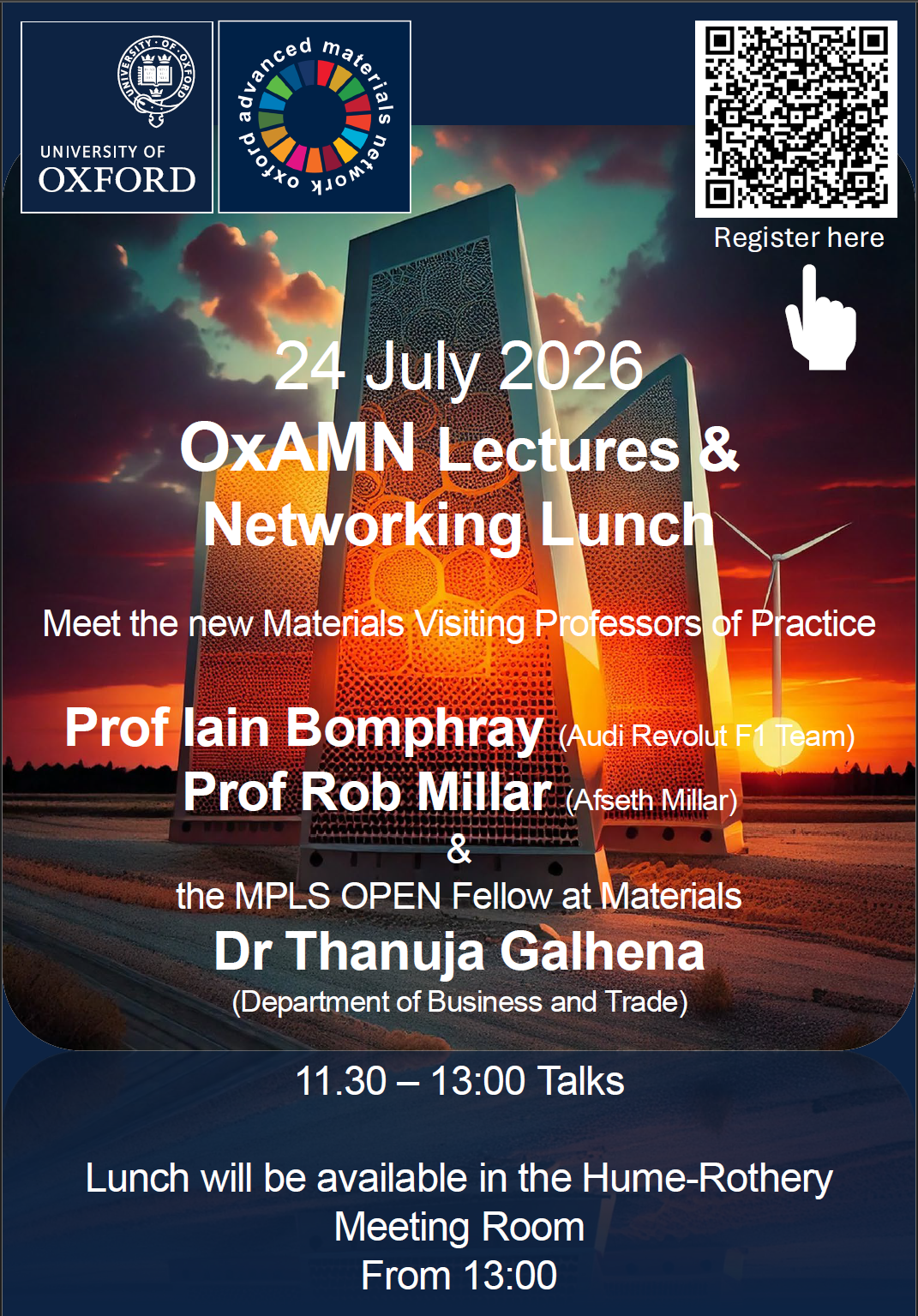
Meet the new Materials visiting Professors of Practice and the MPLS OPEN Fellow at Materials with Networking Lunch
An opportunity to meet the new Materials visiting Professors of Practice and the new MPLS OPEN Fellow at Materials
An opportunity to welcome Professor Iain Bomphray and Professor Rob Millar to the University and the Department of Materials along with Dr Thanuja Galhena the new MPLS OPEN Fellow at Materials. The lectures will begin at 11:30 closing at 13:00 and the networking lunch will start at 13:00 in the Hume-Rothery meeting room. Please register using the link to the online booking form if you would like to attend.
Friday, 24 July 2026, 11.30am to 1.30pm
Speaker(s): Professor Iain Bomphray (Audi Revolut F1 Team), Professor Robert Millar (Afseth Millar Strategic Consulting), Dr Thanuja Galhena (Department of Business and Trade)
Venue:
Hume-Rothery Building - Hume-Rothery Lecture Theatre
Hume-Rothery Lecture Theatre Hume-Rothery Building Parks Road Oxford Oxfordshire OX1 3PH United Kingdom
Department: Materials (Department)
Organiser: Professor Nicole Grobert
Host: Oxford Advanced Materials Network
Series: Oxford Advanced Materials Network Events
Audience: Member of University - ALL Format: In Person
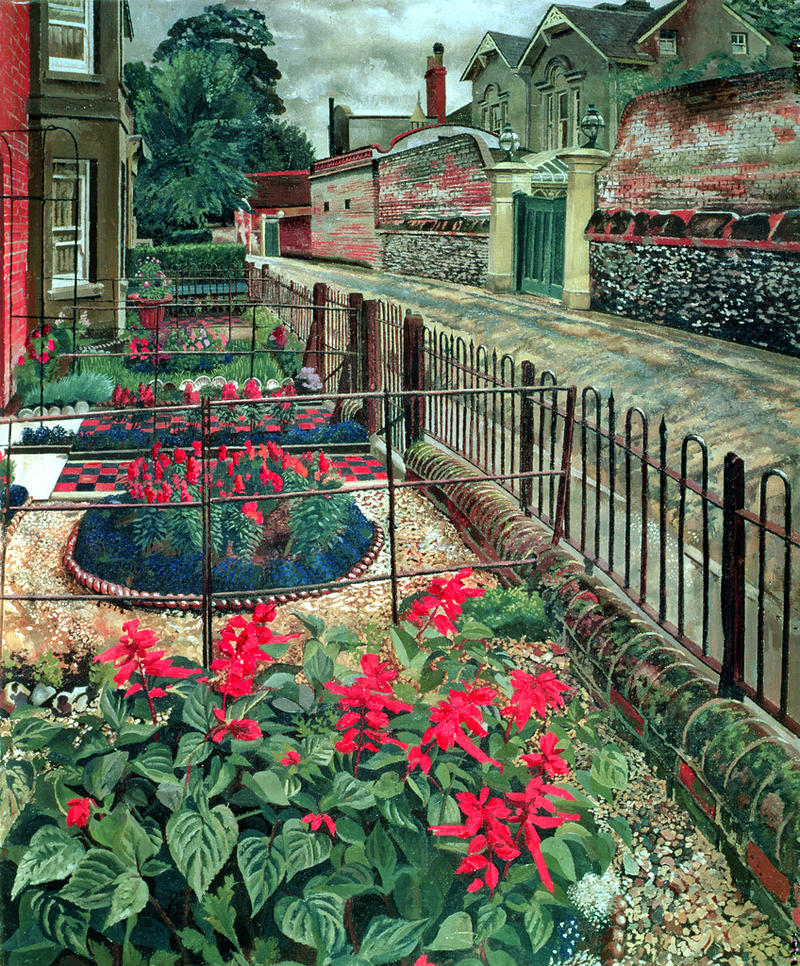
Stanley Spencer's Garden Paintings Talk
In this talk, Peter Vass will be looking at Stanley Spencer's popular flower and garden paintings. Booking required
This event is in-person at the Museum in the Headley Lecture Theatre and online via Zoom Tickets are £8 each. Booking is essential With Peter Vass, art historian Peter Vass will be looking at Spencer’s flower and garden paintings which many critics believe to be his finest works. These magnificent paintings of gardens, houses and landscapes were often set in Spencer's home village of Cookham, depicting small alleys, overgrown backyards, gardens with hedges and fences, mowed lawns and beds that were filled with cottage flowers. These works proved ever popular during his lifetime. Peter will also examine how, in later life, Spencer created the persona of British art’s eccentric genius, pushing his pram of painting materials around Cookham, carrying out his commissions.
Saturday, 25 July 2026, 1pm to 2pm
Department: Ashmolean Museum (Department)
Organiser: Public Programmes
Series: Shaped by Nature Season
Audience: Public Format: Hybrid
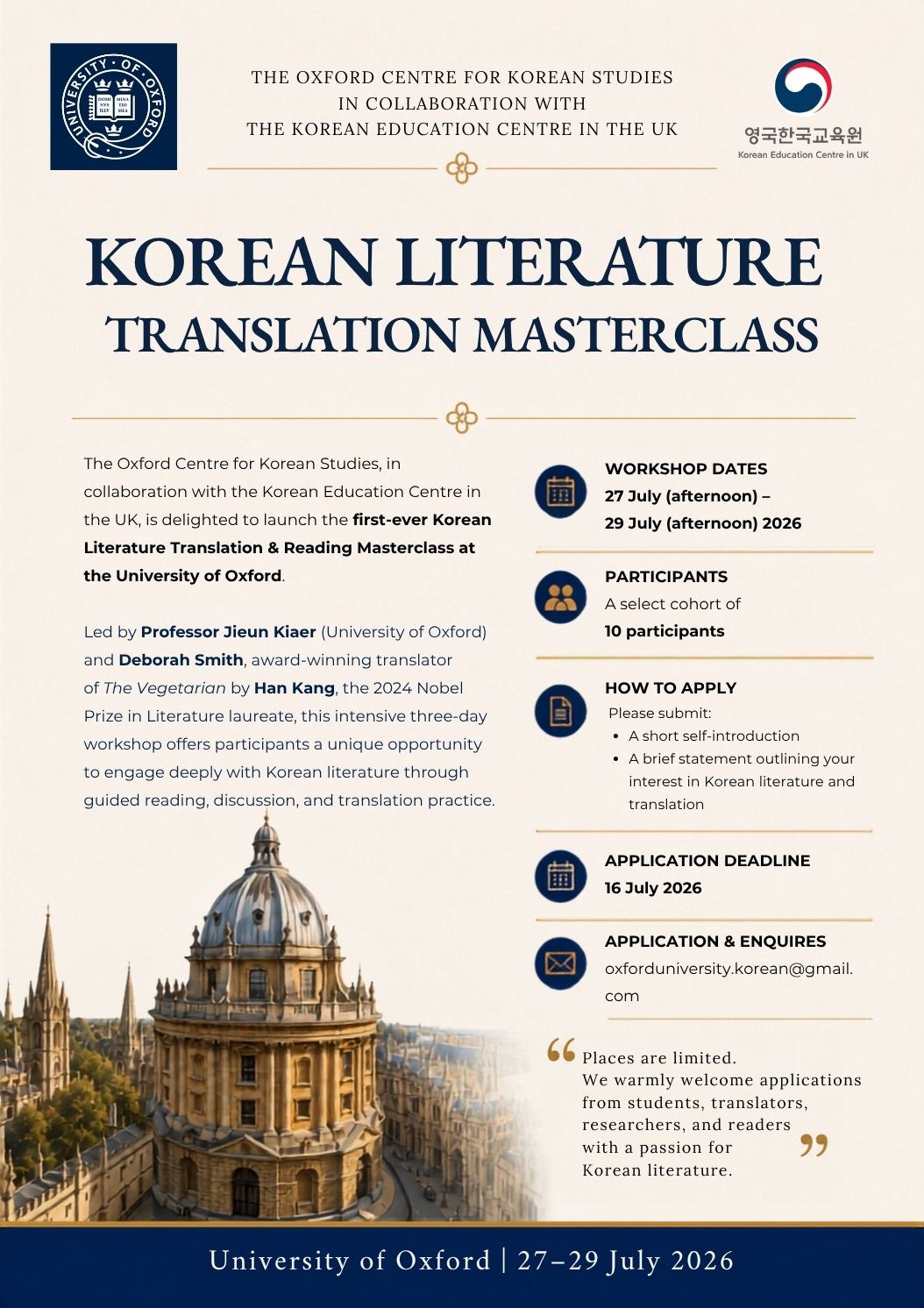
Korean Literature Translation Masterclass
Korean Literature Translation Masterclass at the University of Oxford.
Interested in Korean literature? Applications are now open. Only 10 places available. Apply by Thursday 16 July. Workshop dates: 27 July (afternoon) to 29 July (afternoon) 2026 The Oxford Centre for Korean Studies, in collaboration with the Korean Education Centre in the UK, is delighted to launch the first Korean Literature Translation Masterclass at the University of Oxford. Led by Professor Jieun Kiaer (University of Oxford) and Deborah Smith, the award-winning translator of The Vegetarian by Han Kang, winner of the 2024 Nobel Prize in Literature, this intensive three-day workshop offers a rare opportunity to explore Korean literature through guided reading, discussion, and hands-on translation practice. How to apply: Please email oxforduniversity.korean@gmail.com with: A brief self-introduction. A short statement outlining your interest in Korean literature and literary translation.
Monday, 27 July 2026 to Wednesday, 29 July 2026, 2pm - 6pm
Speaker(s): Professor Jieun Kiaer, Deborah Smith
Department: Asian and Middle Eastern Studies (Department)
Host: Professor Jieun Kiaer (University of Oxford), Deborah Smith
Audience: Public Format: In Person
University of Johannesburg Senior Leadership Team Visit
This is a day-long seminar on African research collaborations and partnerships. If you plan to attend the day in-person, and would like to join the visitors for a light sandwich lunch, please RSVP to zhongyu.wang@education.ox.ac.uk 10.30am Arrivals and Coffee 11am Welcome by Deputy Director of Research Associate Professor Steve Puttick 11.10am Introductions 11.20am Reimagining African Higher Education and the Work of CGHE: Associate Professor David Mills 11.30am Welcome from Kevin Marsh, Director of AfOx (TBC) – Africa Oxford Initiative: 10 years of Building Equitable Partnerships 11.45am Professor Letlokwa Mpedi, VC, UJ: Public Lecture: Enhancing Pan-African Collaboration: Strategies for Access, Digital Inclusion, and Student Success in Higher Education, plus Q&A. This will also be streamed on Teams. Register here to attend online. 12.30pm Lunch Buffet and Networking 1.30pm Professor Juliet Thondlana, University of Nottingham: UNESCO Chair in International Education and Development: Promoting the African Charter and Building Effective Partnerships 2pm Professor Tingting Yuan, Professor of Education, University of Nottingham: The Past, Present and Future China-Africa Educational Partnerships 2.30pm Plenary Discussion and Reflections 3pm Tea and Close
Tuesday, 28 July 2026, 10.30am to 3pm
Department: Education (Department)
Host: Centre for Global Higher Education
Audience: Member of University - ALL Format: In Person
Public lecture: Enhancing pan-African collaboration – Strategies for access, digital inclusion, and student success in higher education
In this keynote, Professor Mpedi sets out a vision for the future of pan-African higher education collaborations, and the importance of widening access and digital inclusion for student success. Emphasising the importance of African research and knowledge production, he will also talk about UJ’s role in creating research and development initiatives between universities and industry, student and faculty exchanges, the creation of dual-degree programmes, and the use of collaborative teaching models.
Tuesday, 28 July 2026, 11.45am to 12.30pm
Speaker(s): Professor Letlhokwa George Mpedi (University of Johannesburg (UJ))
Venue:
15 Norham Gardens - Seminar Room A
Oxford Oxfordshire OX2 6PY United Kingdom
Department: Education (Department)
Organiser: Centre for Global Higher Education
Host: Centre for Global Higher Education
Audience: Member of University - ALL Format: Hybrid
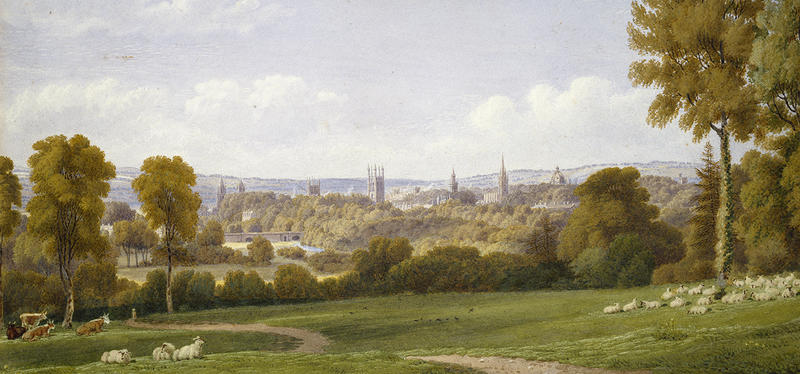
Members' Exclusive Print Room Visit — Spotlight on William Turner 'of Oxford'
Join us for an exclusive Print Room visit with Timothy Wilcox, exploring the works of William Turner. Booking required
An Exclusive Talk for Members of the Ashmolean This event takes place in-person in the New Douce Print Room, meet at the Welcome Desk Choose one of two sessions: 2-3pm or 3-4pm Tickets are £25 each. Booking is essential With Timothy Wilcox, writer, curator and lecturer Join Timothy for this exclusive visit to the New Douce Print Room, exploring the works of William Turner 'of Oxford'. Born just four years after his celebrated namesake J.M.W. Turner, William Turner ‘of Oxford’ lived most of his life in the great man’s shadow. Both were landscape painters, but the local man’s art was no pale imitation of the other’s. Having grown up in the Oxfordshire countryside, Turner ‘of Oxford’ understood that landscape was not an unchanging constant, but a dynamic expression of the lives of the often humble workers who populated it. His concern for physical and social change, from the North of Scotland to the Isle of Wight, is evident from the Ashmolean’s rich collections of his drawings and watercolours.
Tuesday, 28 July 2026, 2pm to 3pm
Department: Ashmolean Museum (Department)
Organiser: Ashmolean Membership
Series: Ashmolean Member Events
Audience: Public Format: In Person
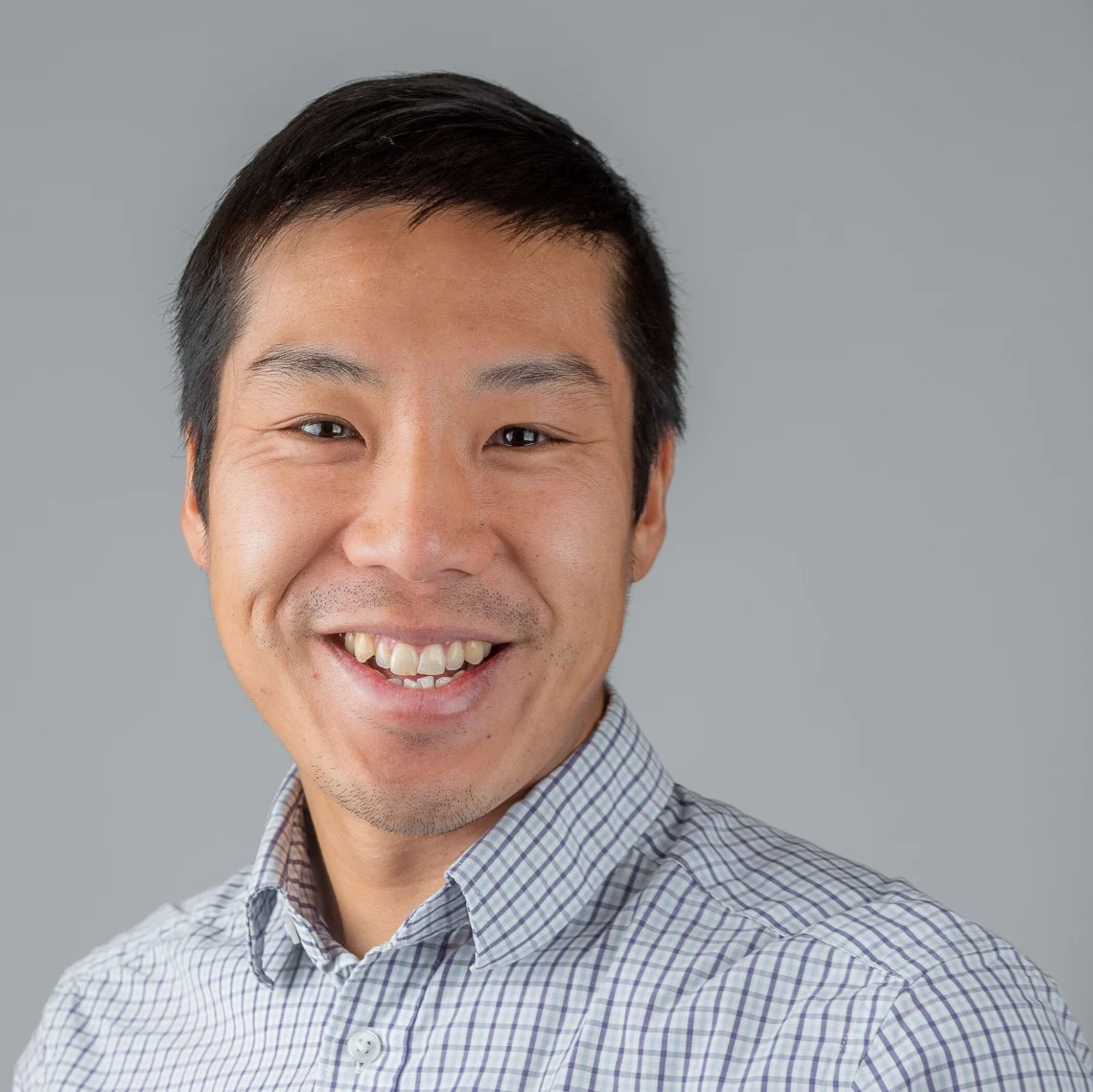
Heralding Intelligent cancer vaccines- designed with AI, improving like ChatGPT, tested then manufactured with robotics, and printed at sites
This is a hybrid event. To join via Zoom, please register in advance: https://us06web.zoom.us/meeting/register/HqvkPrs2QC-egrB303_z3A After registering, you will receive a confirmation email containing information about joining the meeting.
Wednesday, 29 July 2026, 12pm to 1pm
Speaker(s): Dr Lennard Lee (Centre for Immuno-Oncology)
Venue:
Richard Doll Building - Richard Doll Building Lecture theatre
Richard Doll Building Lecture theatre Richard Doll Building Old Road Campus Oxford Oxfordshire OX3 7LF United Kingdom
Department: Jenner Institute (Unit)
Host: Adrian Hill
Series: Jenner Seminars
Audience: Member of University - ALL Format: Hybrid

Meet the Scientists: Try Out Research
Join the Oxford University Experimental Psychology team to take part in real research.
Taking part in these activities will help scientists discover more about children’s behaviour and how their brains work.
Monday, 3 August 2026, 10.30am to 3pm
Venue:
University Museum of Natural History
University Museum of Natural History Parks Road Oxford Oxfordshire OX1 3PW United Kingdom
Venue details:
Westwood Room
Department: Oxford University Museum of Natural History (Department)
Audience: Public Format: In Person
Title TBC - CAMS Oxford Institute Seminar
CAMS Oxford Institute - Seminar Series
CAMS Oxford Institute - Seminar Series
Tuesday, 4 August 2026, 9.30am to 10.30am
Venue:
Henry Wellcome Building Rooms A & B
Room A+B Wellcome Trust Centre for Human Genetics Headington Oxford Oxfordshire OX3 7BN United Kingdom
Department: NDM (CAMS Oxford Institute) (Unit)
Host: Ricardo Fernandes, Dannielle Wellington, Mimie Szyk
Series: CAMS Oxford Institute - Seminar Series
Audience: Member of University - ALL Format: In Person
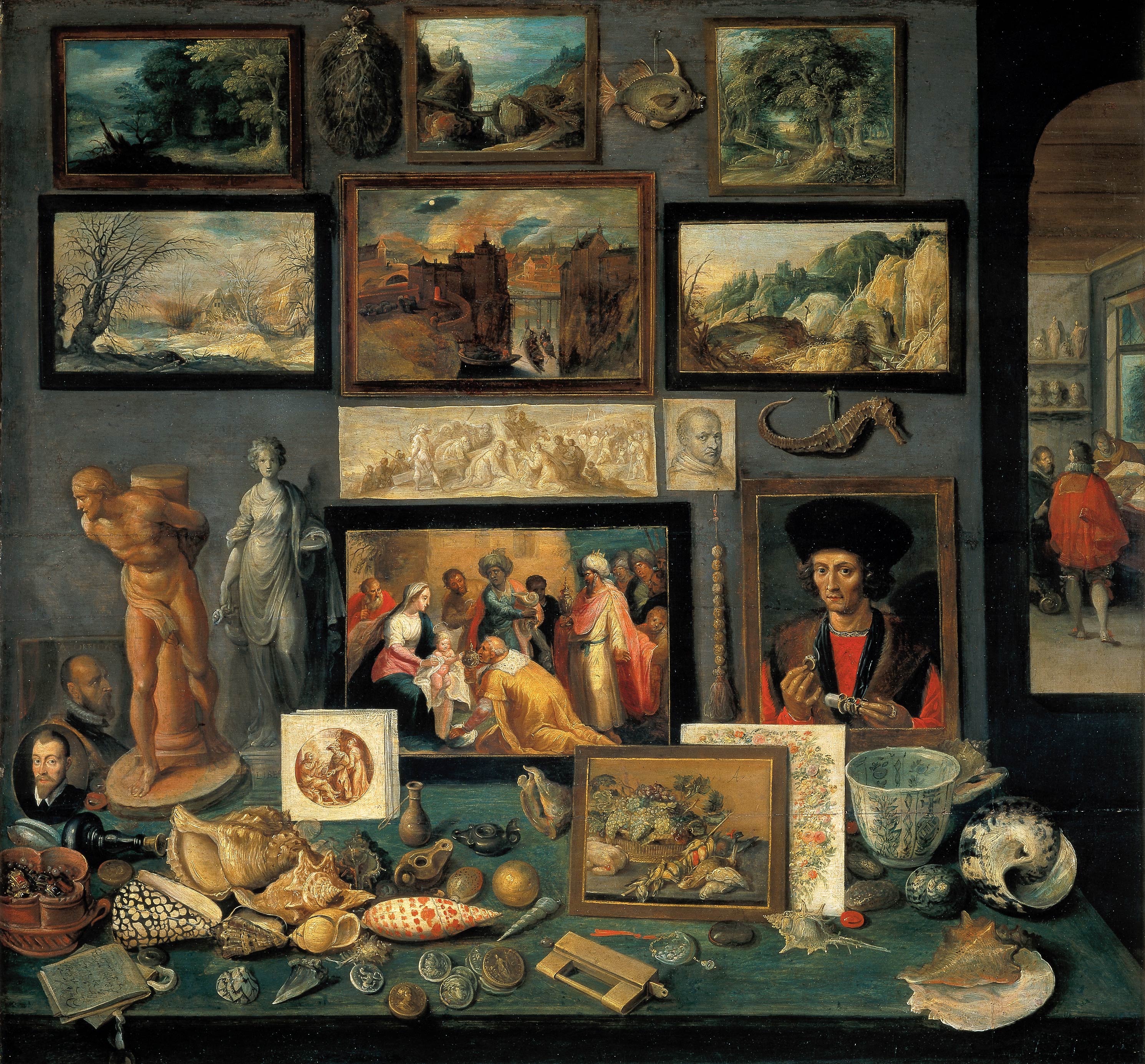
Painting and Genre Conference
A one-day conference exploring genre as a critical framework for the study of painting
Painting genres structure artistic practice, shape reception, and inform institutional frameworks. Yet within art history, the study of genre has often been overshadowed by iconographic and formalist approaches. This one-day conference brings together scholars whose papers place genre at the centre of the analysis of painting, foregrounding it not merely as a classificatory device, but as a critical category through which artistic production, reception, and historiography can be re-examined. Conference programme: 13.45 – Welcome and introduction by Sofya Dmitrieva 14.00-15.00 – Panel 1: Definitions * Emma Barker (The Open University), Defining genre painting * Miles Fletcher (University of Cambridge), Een Algemeen Schilder: Landscape, Technology, and the History of Depiction in England and the Low Countries, 1649–1702 15.00-16.00 – Panel 2: Institutions * Anastasia Skoybedo (University of Cambridge), Landscape Painting within the Soviet Hierarchy of Genres. The case of the Leningrad Landscape School * Alyse Muller (Columbia University), The Genealogy of the Marine Genre in France 16.00-17.00 – Coffee break 17.00-18.00 – Panel 3: Taste * Daniel Sobrino Ralston (National Gallery), The Rise and Fall of a Genre in Second Empire Paris * Vittoria Cervini (Royal Collection Trust), From Carlton House to Buckingham Palace. Seventeenth-century genre paintings in George IV’s collection 18.00-19.00 – Panel 4: Reimaginings * Tom Zille (Mucha Foundation), Queering the Conversation Piece * Sarah Hegenbart (Heidelberg University), Towards Transcultural Pictorial Genres Attendance is free of charge, and no registration is required. A light lunch and refreshments will be provided. Further details can be found via the following link: https://www.seh.ox.ac.uk/events/painting-and-genre-conference
Thursday, 6 August 2026, 1.45pm to 7pm
Venue:
St Edmund Hall - Old Dining Hall
Old Dining Hall St Edmund Hall Queen's Lane Oxford Oxfordshire OX1 4AR United Kingdom
Venue details:
https://maps.app.goo.gl/x57S3jXhurLJNvoM7
Department: St Edmund Hall (College)
Organiser: Sofya Dmitrieva
Audience: Public Format: In Person

Meet the Scientists: Try Out Research
Join the Oxford University Experimental Psychology team to take part in real research.
Taking part in these activities will help scientists discover more about children’s behaviour and how their brains work.
Monday, 10 August 2026, 10.30am to 3pm
Venue:
University Museum of Natural History
University Museum of Natural History Parks Road Oxford Oxfordshire OX1 3PW United Kingdom
Venue details:
Westwood Room
Department: Oxford University Museum of Natural History (Department)
Audience: Public Format: In Person
Count me in: how mathematics explains music - Sarah Hart
Mathematics and Music
The great mathematician Gottfried Leibniz said that music is the pleasure the human mind experiences from counting without being aware that it is counting. We love it, in other words, because it is the mathematics of the subconscious. In this lecture we’ll bring that mathematics into the open and see how mathematical ideas are woven into every aspect of music. We’ll explore the beautiful number patterns underlying harmony, the geometrical symmetries of melody, and the 2000-year-old algorithm that predicts the rhythms most favoured by musicians across the world. Sarah Hart is a mathematician and author. She is Professor Emerita of Mathematics at Birkbeck College (University of London), and Fellow of Gresham College, London. Her first book, Once Upon a Prime: The Wondrous Connections Between Mathematics and Literature won the Mathematical Association of America’s Euler Book Prize. Her forthcoming book on the resonances between mathematics and music will be published in 2027. Please email external-relations@maths.ox.ac.uk to register to attend in person. The lecture will be broadcast on the Oxford Mathematics YouTube Channel on Wednesday 2 September at 5-6 pm and any time after (no need to register for the online version). The Oxford Mathematics Vicky Neale Public Lectures are a partnership between the Clay Mathematics Institute, PROMYS and Oxford Mathematics. The Oxford Mathematics Public Lectures are generously supported by XTX Markets.
Wednesday, 12 August 2026, 5pm to 6pm
Speaker(s): Sarah Hart (Birkbeck)
Venue:
Mathematical Institute - L1
L1 Mathematical Institute Woodstock Road Oxford Oxfordshire OX2 6GG United Kingdom
Venue details:
Lecture Theatre 1
Department: Mathematical Institute (Department)
Organiser: Dyrol Lumbard
Host: Dyrol Lumbard
Series: Oxford Mathematics Public Lectures
Audience: Public Format: In Person

Meet the Scientists: Try Out Research
Join the Oxford University Experimental Psychology team to take part in real research.
Taking part in these activities will help scientists discover more about children’s behaviour and how their brains work.
Monday, 17 August 2026, 10.30am to 3pm
Venue:
University Museum of Natural History
University Museum of Natural History Parks Road Oxford Oxfordshire OX1 3PW United Kingdom
Venue details:
Westwood Room
Department: Oxford University Museum of Natural History (Department)
Host: Oxford University Museum of Natural History
Audience: Public Format: In Person
Title TBC - CAMS Oxford Institute Seminar
CAMS Oxford Institute - Seminar Series
CAMS Oxford Institute - Seminar Series
Tuesday, 18 August 2026, 9.30am to 10.30am
Venue:
Henry Wellcome Building Rooms A & B
Room A+B Wellcome Trust Centre for Human Genetics Headington Oxford Oxfordshire OX3 7BN United Kingdom
Department: NDM (CAMS Oxford Institute) (Unit)
Host: Ricardo Fernandes, Dannielle Wellington, Mimie Szyk
Series: CAMS Oxford Institute - Seminar Series
Audience: Member of University - ALL Format: In Person
Oxford Summer Academy for the Social Science of Health Innovation (SASHI) 2026
Join us for this 3-day summer school exploring translational healthcare innovation
Innovations in healthcare have the potential to vastly improve health outcomes - but they also have downsides including limited uptake, failures of scale-up or sustainability, increases in inequities, and unanticipated inefficiencies. SASHI 2026 will take an interdisciplinary approach to translating healthcare innovations into practice globally
Monday, 24 August 2026 to Wednesday, 26 August 2026, 8.30am - 5pm
Venue:
St Hilda's College
Cowley Place Oxford
Department: Primary Care Health Sciences (Department)
Organiser: Dr Anne Ferrey
Audience: Public Format: In Person
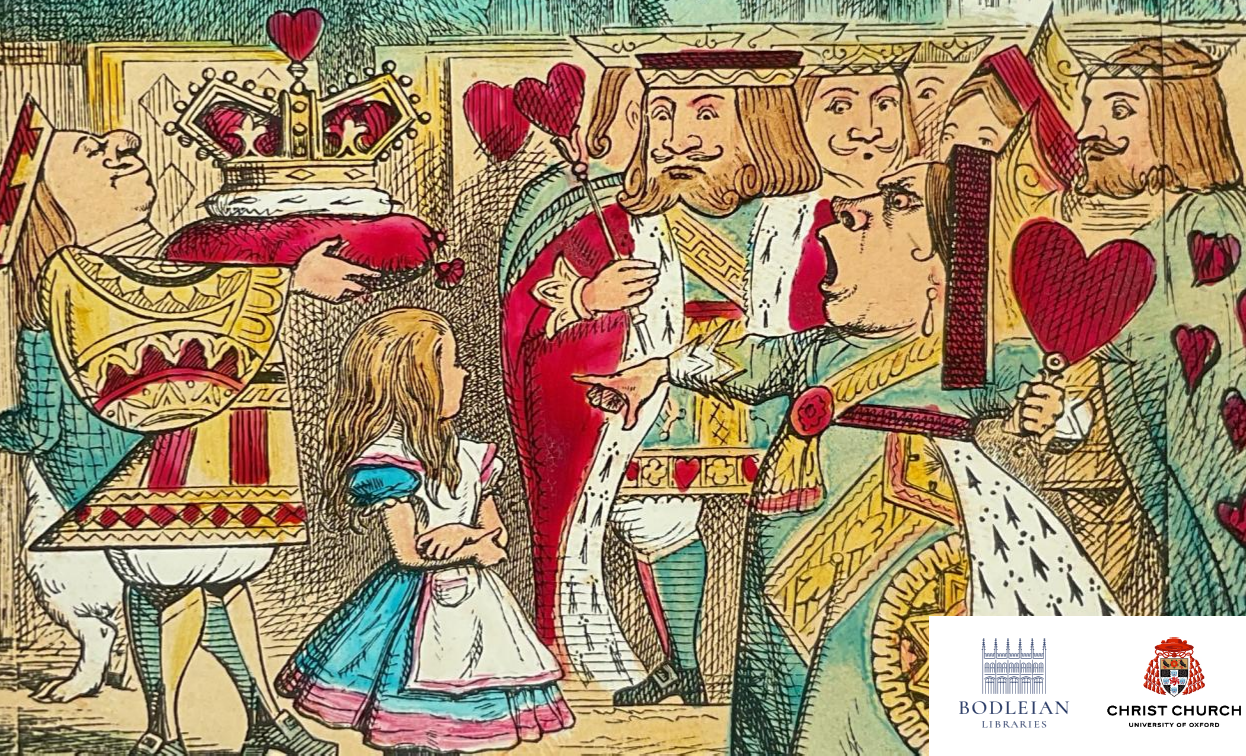
Visiting Fellow Talk: Lewis Carroll: Early Transmedial Storyteller
Professor Alison Halsall will share recent research on Lewis Carroll and illustrator John Tenniel
Professor Alison Halsall (York University, Toronto) will share recent research on Lewis Carroll and illustrator John Tenniel. Professor Halsall, 2026-7 Lewis Carroll Visiting Fellow, will share recent research on how Lewis Carroll and illustrator John Tenniel developed foundational visual storytelling techniques together, based on Professor Halsall's intersecting interests in visual narrative, childhood readership, and archival study. The Lewis Carroll Visiting Fellowship is offered jointly by the Bodleian Libraries and Christ Church, Oxford. The Visiting Fellowship supports researchers from outside Oxford whose work engages with Lewis Carroll and his interests, including children’s literature, literary illustration, 19th-century photography, Oxford history, and the cultural impact of mathematics. Professor Halsall's talk will be followed by refreshments. Free, but booking is essential. We regret that there is no step-free access to the Upper Library.
Thursday, 27 August 2026, 5.30pm to 7pm
Venue:
Christ Church
Christ Church St Aldates Oxford Oxfordshire OX1 1DP United Kingdom
Venue details:
Upper Library
Department: Christ Church (College)
Organiser: Christ Church Library
Host: Christ Church Library
Audience: Public Format: In Person
From the Laboratory to the Clinic 2026: Complex pathogenesis of disease
An annual translational research conference established in 1984, held at Trinity College, Oxford.
The conference brings together an international mix of basic scientists, clinicians, and industry researchers to explore how the latest discoveries in immunology and molecular medicine can be applied to improve clinical medicine. Understanding the pathogenesis of disease underpins successful attempts at therapy. We now have remarkable tools to understand pathogenesis, and in the 2026 conference will highlight four areas where major advances have been made, but much more is needed to reach cures: Metabolism, Microbes, Neurodegeneration & Repair
Tuesday, 1 September 2026 to Friday, 4 September 2026, 9am - 6pm
Venue:
Trinity College
Broad Street Oxford
Department: Kennedy Institute of Rheumatology (Unit)
Audience: Public Format: Hybrid
Title TBC - CAMS Oxford Institute Seminar
CAMS Oxford Institute - Seminar Series
CAMS Oxford Institute - Seminar Series
Tuesday, 1 September 2026, 9.30am to 10.30am
Venue:
Henry Wellcome Building Rooms A & B
Room A+B Wellcome Trust Centre for Human Genetics Headington Oxford Oxfordshire OX3 7BN United Kingdom
Department: NDM (CAMS Oxford Institute) (Unit)
Host: Ricardo Fernandes, Dannielle Wellington, Mimie Szyk
Series: CAMS Oxford Institute - Seminar Series
Audience: Member of University - ALL Format: In Person